
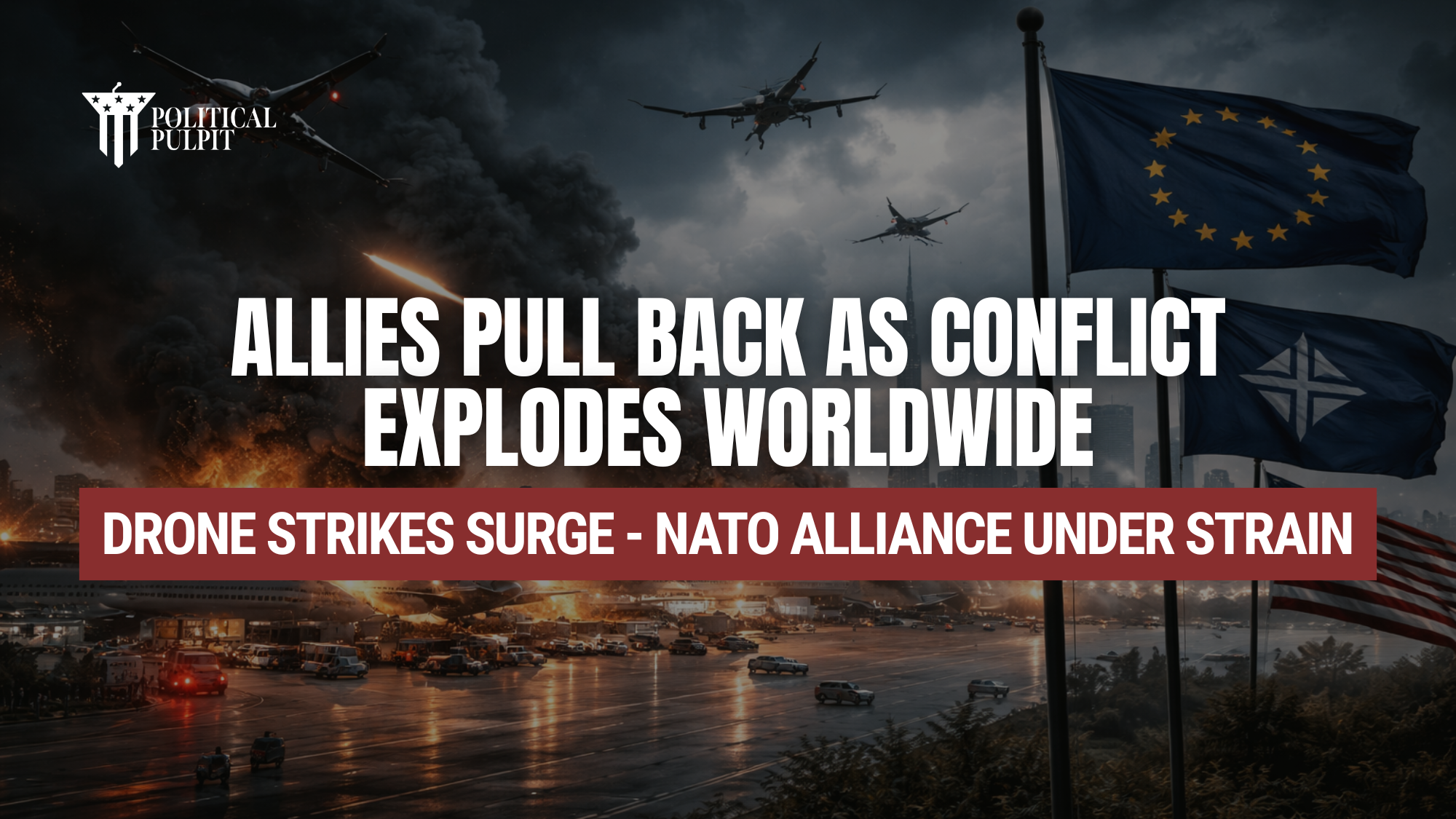
The conflict with Iran is no longer contained.
What began as a regional escalation is now rapidly evolving into a global flashpoint, with rising tensions stretching far beyond the Middle East and raising a sobering question:
Is America beginning to stand alone on the world stage?
Recent developments have intensified those concerns. Reports of drone-related disruptions near major international hubs, including airports in the Gulf region such as Dubai, have added a new layer of instability to an already volatile situation. These incidents are not just symbolic they threaten global travel, commerce, and security.
At the same time, a growing number of European allies are hesitating or outright refusing to join expanded U.S. military efforts against Iran.
And within NATO, the cracks are becoming harder to ignore.
A Shifting Global Alignment
For decades, the United States has relied on strong alliances to project stability and deterrence across the world.
But today, that unity appears to be under strain.
European leaders have expressed concerns about escalation, economic fallout, and the long-term consequences of deeper involvement in the conflict. Some are calling for restraint, diplomacy, and de-escalation—while the U.S. continues to push forward with a more aggressive posture.
This divergence is fueling speculation that a major geopolitical realignment may already be underway.
If allies begin to distance themselves, it could mark a turning point in how global power is structured.
The Economic and Security Ripple Effects
The consequences of this shift are already being felt.
- Global markets are reacting with volatility
- Oil supply routes remain under threat
- Air travel disruptions are increasing
- Military tensions are spreading across multiple regions
This is no longer just a military issue.
It is a global systems issue—impacting economies, infrastructure, and international cooperation.
And for Americans, it raises serious questions about the future:
- Will the U.S. bear the burden alone?
- Can alliances be rebuilt under pressure?
- What happens if global cooperation continues to weaken?
A Moment of Uncertainty—and Prophetic Reflection
For believers, this moment carries deeper significance.
Scripture reminds us that in the last days, nations will be shaken, alliances will shift, and uncertainty will increase.
“Nation will rise against nation, and kingdom against kingdom…” — Matthew 24:7
We are witnessing a world where long-standing partnerships are being tested—and where the balance of power is no longer guaranteed.
But this is not a call to fear.
It is a call to awareness, readiness, and faith.
What the Church Must Do
In times of global tension, the church must rise with clarity and purpose.
We are called to:
- Pray for peace among nations
- Pray for wisdom for global leaders
- Pray for protection over civilians and troops
- Pray against division, deception, and escalation
And we must remain grounded in the truth that God’s sovereignty is greater than any global conflict.
Final Word
The world is shifting.
Alliances are being tested.
Conflicts are expanding.
And uncertainty is growing.
But in the midst of it all, one thing remains constant:
God is still in control.
And as history unfolds before our eyes, the church must stand firm—watchful, prayerful, and ready.
Subscribe to the Political Pulpit newsletter for more faith-centered reporting, and join the fight for truth, justice, and global religious freedom.
Watch our broadcasts at Watch.OSN.tv — use promo code JOSH
Support our mission at www.politicalpulpit.com/partner
The time to speak is now.
The time to act is now.
The time to pray—for peace, unity, and wisdom in a shifting world—is now.