
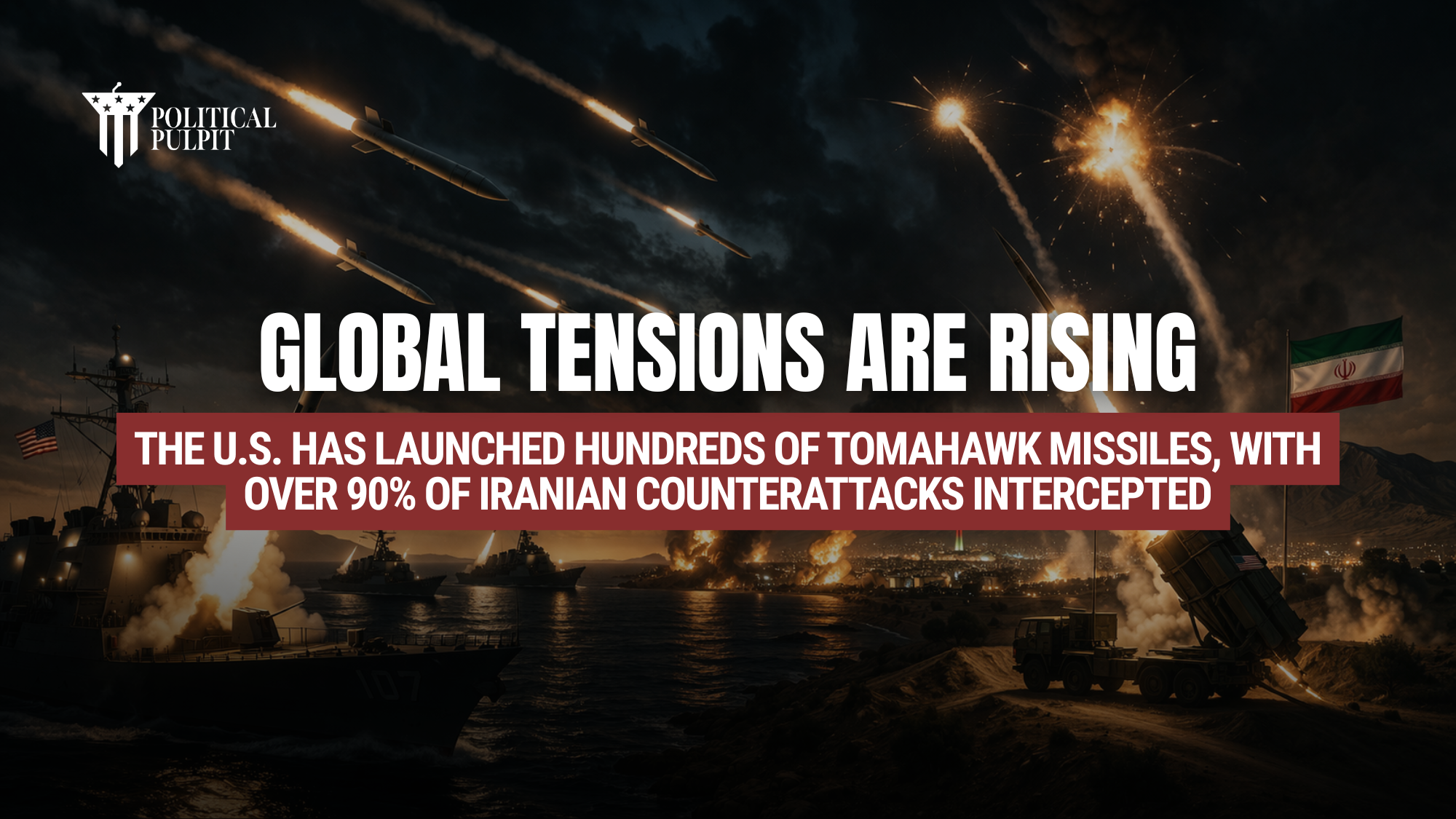
The conflict between the United States and Iran has reached a dangerous new level, and the world is watching closely. Recent US Iran conflict escalation has involved Tomahawk missiles, further increasing global tensions.
Recent reports indicate that U.S. forces have launched hundreds of Tomahawk cruise missiles targeting Iranian military infrastructure. At the same time, defense systems have intercepted more than 90 percent of Iran’s retaliatory strikes, highlighting both the scale of the confrontation and the effectiveness of modern missile defense.
This is no longer a limited exchange.
It is a full-scale escalation with global implications.
A Massive Show of Force
The deployment of Tomahawk missiles represents a significant increase in U.S. military action. These long-range precision weapons are designed to strike critical targets with accuracy, and they have been used to hit key Iranian positions.
Targets reportedly include:
Military installations
Missile launch sites
Strategic command centers
As a result, Iran’s operational capabilities have been weakened, at least in the short term. However, the situation remains fluid, and further developments are expected.
Interceptions Prevent Wider Damage
While Iran has launched counterattacks in response, reports suggest that U.S. and allied defense systems have intercepted the majority of incoming missiles and drones.
Systems such as Patriot and other advanced intercept technologies have played a critical role in limiting damage. Because of this, large-scale destruction has been avoided in many targeted areas.
However, interception does not eliminate risk.
Each launch raises the potential for escalation, miscalculation, and broader conflict.
A Region Under Pressure
The Middle East now sits under intense pressure as tensions continue to rise.
Energy markets are reacting.
Allied nations are assessing their positions.
Military readiness is increasing across multiple regions.
At the same time, the Strait of Hormuz remains a key concern, as any disruption there could impact global oil supply and economic stability.
Because of this, the situation extends far beyond the immediate region. It is a global issue.
A Test of Endurance
This conflict is not just about firepower. It is about sustainability.
Launching and intercepting missiles at this scale places significant strain on resources. Both offensive and defensive systems rely on stockpiles that are not unlimited.
As a result, the longer the conflict continues, the more pressure builds on all sides.
This raises a critical question.
How long can this continue without expanding further?
A Spiritual Wake-Up Call
In moments like this, the instability of the world becomes clear.
Scripture reminds us that nations will rise and conflicts will come, yet we are not called to live in fear.
We are called to stand firm.
Faith does not ignore reality.
It anchors us in it.
What the Church Must Do
As tensions rise, the response of believers must be intentional.
We are called to:
Pray for peace in the Middle East
Pray for protection over civilians and military personnel
Pray for wisdom among world leaders
At the same time, we must remain grounded, knowing that uncertainty does not remove God’s authority.
Final Word
The U.S.–Iran conflict is intensifying.
Missiles are being launched.
Defenses are being tested.
And the world stands on edge.
However, even in the middle of rising tension, one truth remains steady.
God is still in control.
Subscribe to the Political Pulpit newsletter for more faith-centered reporting, and join the fight for truth, justice, and global religious freedom.
Watch our broadcasts at Watch.OSN.tv — use promo code JOSH
Support our mission at www.politicalpulpit.com/partner
The time to speak is now, the time to act is now. The time to pray for peace, protection, and wisdom in a world on edge is now.