

A massive escalation in the Middle East is sending shockwaves across the global economy—and the impact could last for years.
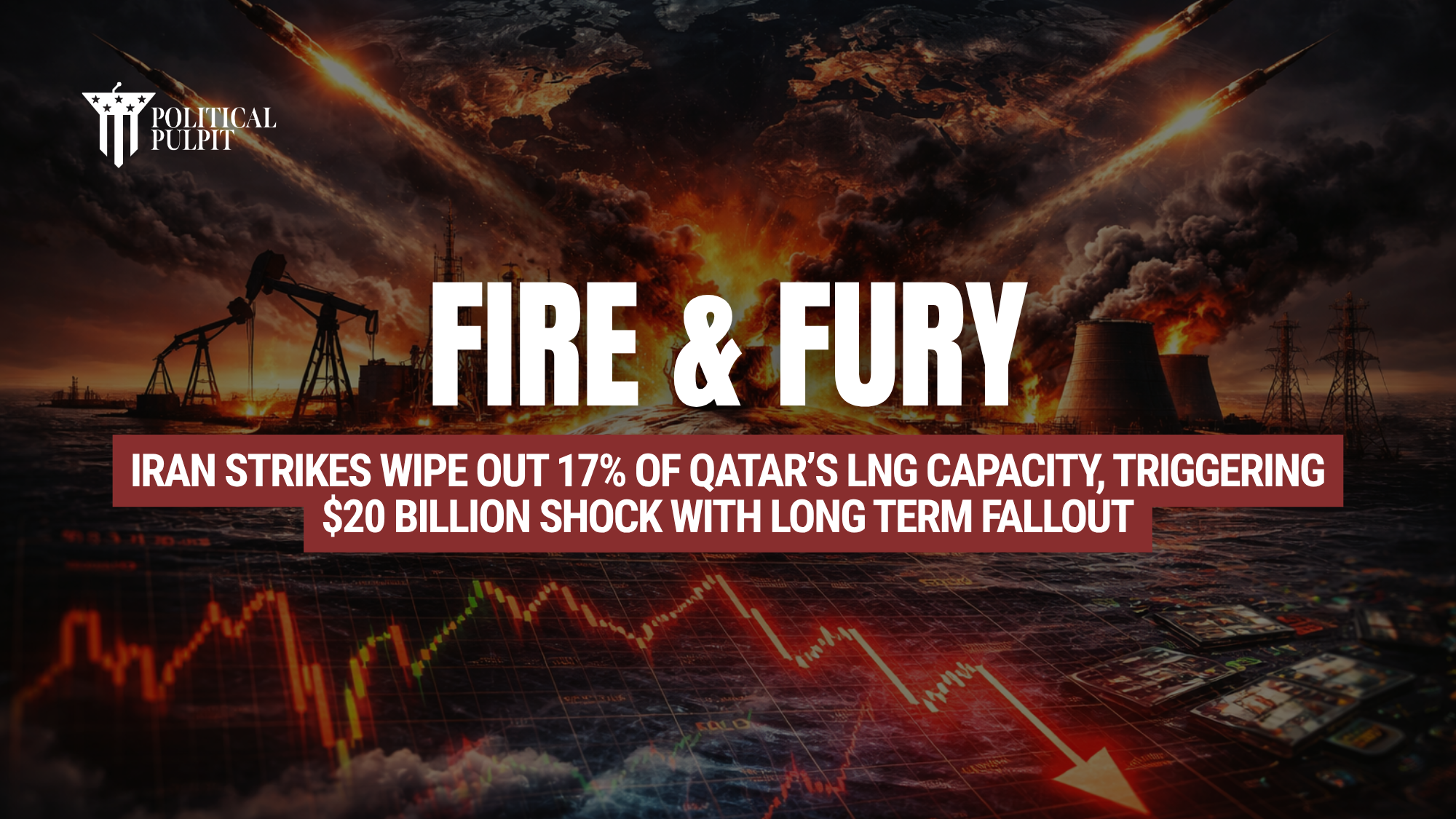
In a stunning development, Iranian strikes on Qatar’s critical energy infrastructure have reportedly eliminated approximately 17% of the nation’s liquefied natural gas (LNG) capacity, dealing a devastating blow to one of the world’s most important energy suppliers.
The damage is not temporary.
Officials warn the disruption could last three to five years, with an estimated $20 billion in annual revenue losses, sending ripple effects through global markets.
This is not just a regional issue.
This is a global energy crisis in the making.
A Direct Hit to the World’s Energy Supply
Qatar is one of the largest exporters of liquefied natural gas in the world—supplying energy to Europe, Asia, and beyond.
Its Ras Laffan complex alone accounts for a significant portion of global LNG production.
Now, with multiple facilities damaged and production capacity slashed, the consequences are immediate:
- Global gas prices are surging
- Supply chains are tightening
- Nations are scrambling for alternatives
Some countries are already bracing for shortages, while others are turning to the United States and other producers to fill the gap.
But there’s a problem:
There may not be enough supply to replace what’s been lost.
Economic Shockwaves Are Already Spreading
Energy is the foundation of modern economies.
When it is disrupted, everything is affected.
From transportation to manufacturing to household utilities, rising energy costs quickly translate into higher prices across the board.
And that means:
- Higher gas prices
- Increased cost of goods
- Greater financial pressure on families
In short—what happens in Qatar doesn’t stay in Qatar.
It reaches every home.
A Dangerous Escalation
These strikes mark a significant escalation in the ongoing Iran conflict.
Energy infrastructure has now become a primary target—raising fears that additional attacks could follow.
And if more facilities are hit, the situation could spiral even further.
The Strait of Hormuz—through which a significant portion of the world’s energy supply flows—remains under threat, amplifying global uncertainty.
This is not just about war.
This is about control of global resources.
A Spiritual Wake-Up Call
For believers, moments like this are more than geopolitical.
They are reminders.
Reminders that the systems of this world are fragile.
Reminders that security can shift overnight.
And reminders that our trust must be placed in something greater.
Scripture tells us:
“God is our refuge and strength, a very present help in trouble.” — Psalm 46:1
When economies shake, when nations clash, when uncertainty rises—
God remains constant.
What the Church Must Do
In times like these, the church must rise with clarity and conviction.
We are called to:
- Pray for peace in the Middle East
- Pray for protection over innocent lives
- Pray for stability in global markets
- Pray for provision for families facing rising costs
And we must stand firm—not in fear, but in faith.
Final Word
The destruction of a significant portion of Qatar’s LNG capacity is more than an energy story.
It is a warning.
A warning of how quickly the world can change.
A warning of how fragile global systems truly are.
And a warning that we must be spiritually prepared.
Because while the world reacts—
The church must respond.
Subscribe to the Political Pulpit newsletter for more faith-centered reporting, and join the fight for truth, justice, and global religious freedom.
Watch our broadcasts at Watch.OSN.tv — use promo code JOSH
Support our mission at www.politicalpulpit.com/partner
The time to speak is now.
The time to act is now.
The time to pray—for peace, provision, and stability in a shaken world—is now.